Achilles
Metamorphoses (Ovid Edition)Achilles stands in the poem as one of the Greek heroes whose violence determines the scale of the Trojan War. His importance is established not through a complete biography but through the consequences of his presence: Greek attacks leave the Sigaean shore covered with corpses, and Trojan leaders learn at their cost what deaths the Greek champions can inflict. The narrative therefore makes Achilles significant as both an individual warrior and a measure of heroic force—an embodiment of battlefield excellence whose power cannot finally exempt him from death.
Identity and Martial Reputation
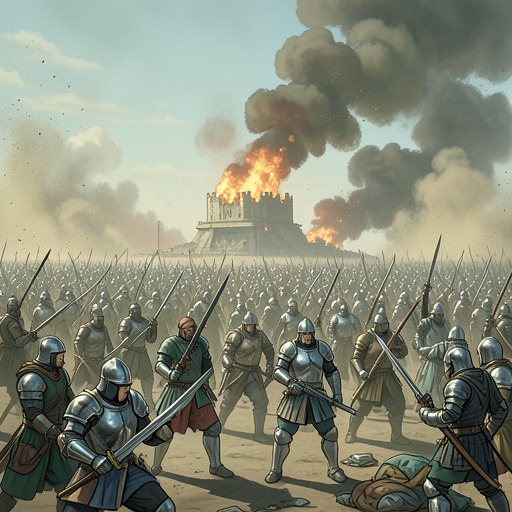
Achilles belongs to the Greek heroic host opposing Troy and is associated with the destructive energy of the war itself. When the first assaults begin, the shore is strewn with carcasses and stained with blood, while the Trojan leaders experience the effectiveness of the Greek heroes in direct and costly form. Although the passage names the wider company rather than assigning every slain enemy to Achilles alone, its placement within the account of his career makes him part of the heroic power responsible for this devastation.
His reputation is thus collective and personal at once. Achilles is not merely another combatant in a confused battle: the surrounding narrative treats the Greek champions as agents whose attacks alter the fate of armies, and Achilles stands at the center of that heroic tradition. The poem’s emphasis falls less on military strategy than on the physical proof of prowess—corpses, blood, repeated blows, and the ability to continue combat after the ordinary conditions of battle have been disrupted.
Combat and the Logic of Heroic Violence
The battle narrative presents Achilles through movement and renewed action. A warrior leaps headlong from his lofty chariot and resumes the fight on foot, repeating his blows with raging disdain. This transition from chariot combat to close fighting concentrates the heroic ideal into a visible gesture: when one mode of attack no longer suffices, the warrior abandons his vehicle and enters the danger directly.
That scene also gives Achilles’ world its characteristic rhythm. Heroic combat is not a single exchange with a neat conclusion; it advances through impact, exhaustion, and renewed aggression. The body becomes the instrument through which honor is asserted, while the battlefield records the result in wounds and death. Achilles’ significance lies within this system of escalating force, where courage is proved by proximity to danger and where martial identity is sustained by the capacity to strike again.
Conflict with Cygnus
Achilles is the principal opponent in the story of Cygnus. The conflict is framed against the Trojan War and begins amid the violence of the Sigaean fighting, where the Greek heroes’ attacks have already produced widespread slaughter. Cygnus, the son of Neptune, enters this martial world as a formidable adversary, and the contest places Achilles against an opponent whose apparent invulnerability makes ordinary weapons ineffective.
The episode’s central reversal is that visible violence does not necessarily reveal actual injury. A lance has drawn blood from the already slain Menoetes, and that blood remains in view, but no wound marks the opponent being challenged. Achilles must therefore confront a body that seems to resist the ordinary logic of battle. The hero’s response is not withdrawal: the fight proceeds at close quarters, and the repeated blows express his determination to overcome resistance through continued force.
The struggle consequently tests more than physical strength. Achilles’ martial identity depends on the assumption that a sufficiently powerful warrior can convert attack into victory, while Cygnus exposes the limit of that assumption. The battle turns heroic confidence into an encounter with an adversary who cannot be subdued by straightforward penetration. In this sense, the episode prepares the larger pattern of Achilles’ story: the strongest warrior remains subject to conditions that his strength alone cannot master.
Death and Aftermath
The poem explicitly marks the Death of Achilles as a later event in the Trojan sequence. The account returns to Neptune, who laments his son Cygnus after the battle, while the surrounding narrative moves toward the death of Achilles himself. This juxtaposition binds the two opponents together: each is defined by martial conflict, and each leaves a bereaved divine or familial figure behind.
Achilles’ death is not treated as a cancellation of his heroic status. Rather, it completes the paradox governing his portrayal. The warrior whose name is associated with Greek victory and whose combat helps stain the shore with blood is still brought within the universal order of mortality. His end gives retrospective meaning to his earlier violence: battlefield supremacy can produce corpses and terror, but it cannot create permanent exemption from fate.
Narrative Role and Significance
Achilles functions as a concentrated image of heroic power in a poem devoted to transformation. Around him, bodies resist, suffer, and change the meaning of what can be seen: blood may appear without a wound, a combatant may leave one form of fighting for another, and the greatest warrior may pass from living force into remembered death. His story therefore links martial spectacle with the poem’s broader concern that no condition remains fixed.
The narrative also places Achilles within a recurring structure of conflict, reversal, and consequence. His opponents’ apparent strength challenges the confidence of force; his own death challenges the belief that excellence can secure permanence. The result is not a simple celebration of conquest. Achilles is memorable because he is both the agent of heroic violence and its eventual subject, a figure whose exceptional power makes his mortality more—not less—significant.